Article
Virtual assistant or full-time employee? How much is doing everything yourself really costing you
5-minute read


Would
Wiktoria Pawlak
The founder of The Assist.
Share
Once, an assistant was a privilege of the few. Today, not having one is a mistake. Just 10 years ago, a personal assistant was reserved exclusively for CEOs, boards of large corporations, and owners of huge enterprises. Today, this model has fully reversed, and most small and medium-sized entrepreneurs do not know it yet. No matter how large a business you run, you can have a real right hand in life and business - a virtual assistant.
In the digital era and with flexible cooperation models, running a business without operational support has ceased to be a sign of thriftiness. It has become a common mistake that limits business growth and leads to rapid professional burnout for the owner.
How much does a full-time employee really cost in a small business?
Hiring a full-time employee is not just the gross salary amount you see on the contract. It is a whole series of hidden costs and legal-organizational obligations that directly burden the company's budget:
Recruitment and onboarding costs: Hours spent reviewing resumes, conducting interviews, and the first weeks of learning procedures.
Fixed obligations: Social security (ZUS), paid annual leave, sick leave (L4), and occupational medicine examinations.
Workspace organization: Purchasing a computer, software, desk, chair, and paying for office space.
Management time: The need to constantly supervise work, motivate, and hold accountable for daily tasks.
Turnover risk: The probability that after 3 months of a probationary period, it will turn out to be the wrong person and the whole process has to start all over again.
Why are entrepreneurs afraid of delegating tasks?
The lack of decision to implement support rarely stems from a lack of need. Most often, the reason is
fear of the change process itself:
Fear of finding the right person and verifying their competencies.
Fear of a difficult and time-consuming process of onboarding into the company's procedures.
The risk that the hired assistant will disappear or get sick at the least appropriate moment.
These are fully justified concerns. And they are exactly what makes many business owners prefer to do
everything themselves instead of trusting unproven solutions.
Virtual assistant vs. full-time employee - key differences:
A virtual assistant is not simply a "cheaper replacement for an employee" - it is a completely different, more modern model of operational cooperation. You do not sign an employment contract, go through complex recruitment, or pay social security contributions or for a desk. You pay only for actual hours worked, tailored to the current needs of your business.
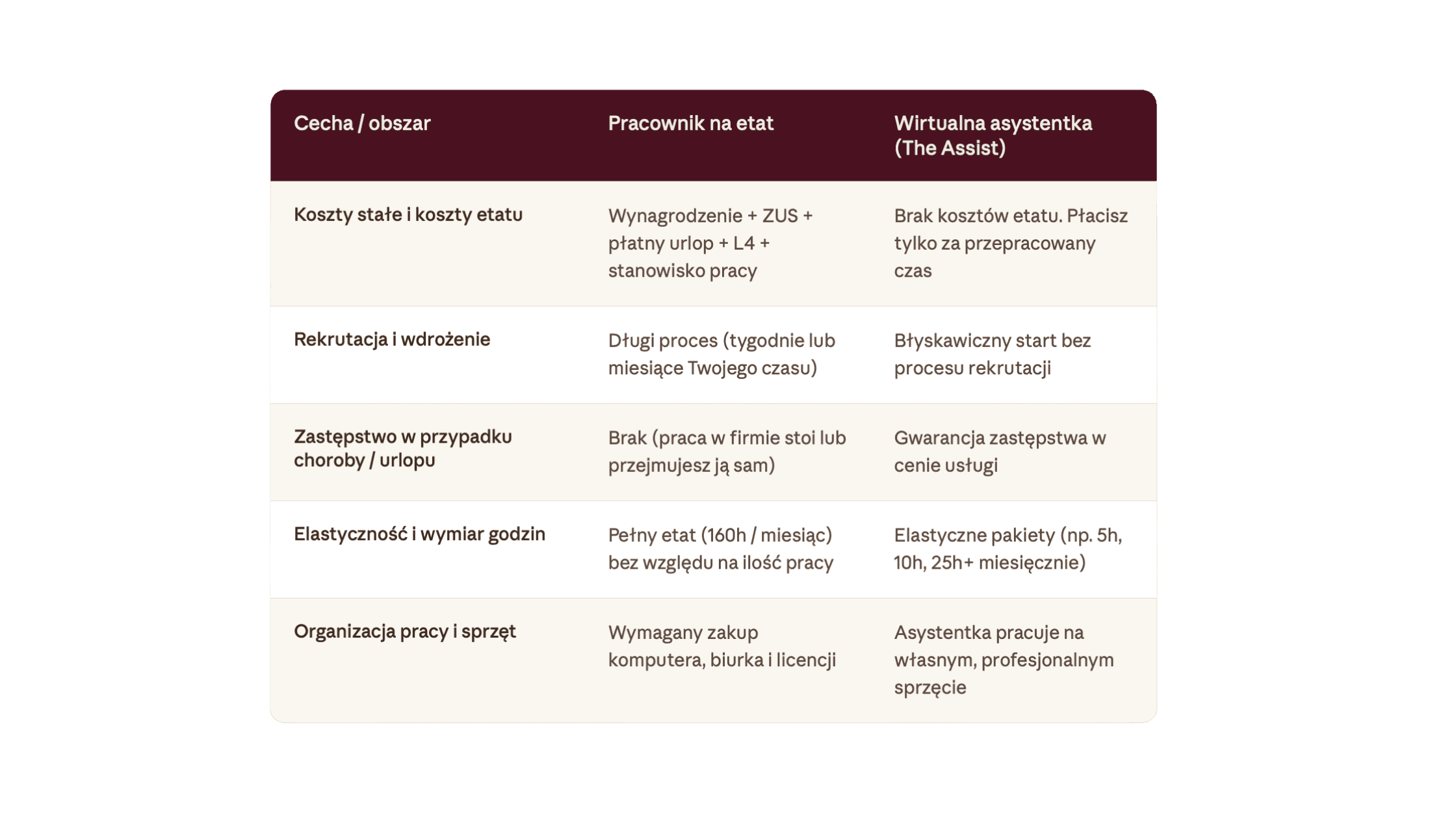
What if the virtual assistant gets sick or takes a vacation?
This is one of the most common objections from entrepreneurs, and rightly so. When the only employee in a company goes on sick leave, work comes to a standstill. That is why a professional agency offers a replacement guarantee. If your dedicated assistant is unavailable, you immediately receive support from another qualified person, without having to onboard them from scratch. The continuity of processes in your company stops being your worry.
How to match a virtual assistant to your industry?
Working with us is not about assigning a random person from a database. A dedicated virtual assistant or remote manager is precisely matched to the specifics of your industry, individual working style, as well as the required experience.
How many hours of support do you really need?
Before making a decision, it is worth doing a simple exercise. Write down on a piece of paper all daily life and business tasks from the last week - from finding a contractor, children's activities, scheduling, arranging meetings, administration, replying to emails, issuing invoices, debt collection, bookings, or contacting suppliers.
Then calculate how many hours a week these activities actually take. In most small and medium-sized businesses, it turns out to be 10 to 20 hours a month, rather than a full 160 hours of full-time employment. Paying for a full-time position is sometimes not necessary.
A question worth asking yourself
Many entrepreneurs ask: "Can I afford a virtual assistant?". However, the correct question to ask yourself is: How much does it really cost me to keep doing all of this myself?
It is time to start delegating and regain time for what is important. Contact us and send us your task list, we will take care of the rest.
Time is the most valuable currency, which cannot be recovered.